

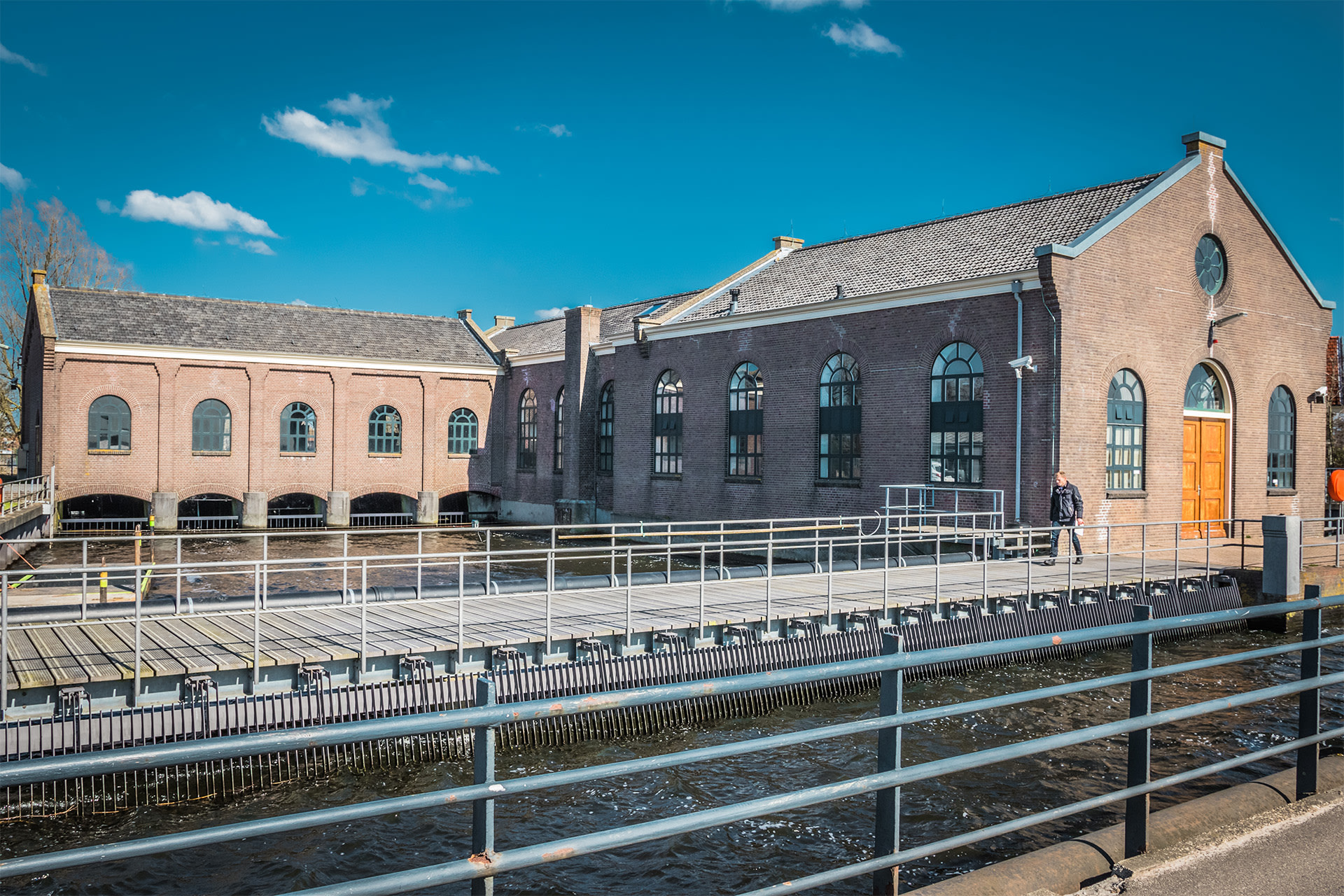

07. Boezem pumping station Spaarndam - Spaarndam

The boezem pumping station in Spaarndam was built in 1844. It was constructed after the drainage of the Haarlemmermeer. The pumping station had to discharge water from the Rijnland area to the IJ. The design was by engineer J.A. Beijerink, a Dutch hydraulic engineer. He is mainly known for the reclamation of the Haarlemmermeer and a design for partial reclamation of the Zuiderzee, the so called Plan Beijerinck.
The pumping station had a capacity of 180 hp and powered ten large wooden scoop wheels. The construction did not go entirely smoothly. The first test was disappointing and the builder, Dixon and Co., was replaced in 1845. With the help of British engineers, the pumping station was officially put into operation in 1846.
At first the pumping station operated on steam. Later this became diesel. Since 2017 it runs on electric motors. The wooden scoop wheels are still present, a special piece of 19th century technology. The scoop wheels are large and turn slowly. In this way they can move a lot of water without it breaking or foaming.
Together with three other boezem pumping stations in Halfweg, Gouda and Katwijk, the pumping station regulates the water level in Rijnland. When too much water enters the boezem, these pumping stations quickly pump it out. In this way the land remains dry.

07. Boezem pumping station Spaarndam
Pol 52
2063 JN
Spaarndam
Contact details


